
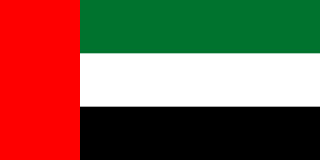
The flag of the United Arab Emirates

CIA World Factbook map of the United Arab Emirates
As on most of the Arabian Peninsula, the Arab Emirates entered the modern era devout but dirt-poor, thanks to its harsh desert climate. The small emirates in the area were renowned for harassing the British with piracy - another famous economic activity in the area was pearl diving. Eventually, the British decided to do something about all the pirates. In 1820, the first treaties were signed with the minor emirates on the "Pirate Coast", treaties that eventually established a British protectorate over the region. These British-protected countries became known as the "Trucial States". As in other parts of the Arabian Peninsula, the individual emirates retained considerable autonomy, thanks to the fact that they had nothing worth taking except for their strategic location. At the time, the emirates used the British Indian rupee.
In the middle of the 20th century, a few new currencies were being established in the Middle East. The Indian government, having broken free from British rule, began to issue a special "Gulf rupee" in order to crack down on the illegal movement of gold between India and the Gulf (just one of the many wonderful complications that can happen when you use the "simple" gold standard).


A Gulf rupee and a normal rupee: Gulf rupee notes are distinguished from normal Indian rupee notes by their colour and their serial number, which begins with "Z". They are also much rarer.
The Indian government devalued the rupee in 1966, which motivated the countries of the Gulf to establish new currencies of their own. Now, many of these small emirates were treated interchangeably, and the British weren't exactly sure how they should give their disparate Arab colonies independence. So, at the time, a few currency unions were established, straddling borders that are now international. Between 1966 and 1973, Qatar and Dubai (but not the other six emirates) entered a currency union, and the Qatar and Dubai riyal is a precursor to both the Qatari riyal and the UAE dirham. Another currency union emerged in 1966 - Abu Dhabi and Bahrain both used the Bahraini dinar. The Saudi riyal also saw some use.


Coins from Bahrain and Qatar and Dubai
In 1971, the UAE finally gained independence. Kuwait, Qatar, and Bahrain had all become independent before that date and were not included in the UAE, perhaps because of their size or physical separation - the seven remaining Trucial emirates, all bordering each other, became the United Arab Emirates.
These seven individual emirates (except for the two important ones, Abu Dhabi and Dubai) each issued non-circulating gold and silver coins during the 1960s and 1970s, which were meant to be sold to collectors. Coins from these emirates are quite expensive today, but if you complete your emirate collection, you will add no less than 5 new countries to your Numista collection! I'm sure many members of the "300 Club" have at least one of these Emirates in their collection. Here is a map of the seven emirates:

And here are some relevant links:
Numista page for Ajman
Numista page for Fujairah
Numista page for Ras al-Khaimah
Numista page for Sharjah
Numista page for Umm al-Quwain
Now we can discuss the UAE as a whole, and the modern coins that it issues. The UAE dirham is worth about USD $0.27, and coins have been issued with denominations ranging from 1 fils (1/100 dirham) to 1 dirham. Like its neighbours in the Gulf, the UAE has had a stable currency since independence and its coins have not seen a lot of radical changes. These coins should not give anybody any difficulty during identification - they all clearly state the country's name on them. However, the Arabic-only denominations reportedly give some expatriates quite a bit of trouble when they first arrive.


Small denominations. 1 fils coins are no longer in use. In 1995, the 5 and 10 fils coins were reduced in size, perhaps to save valuable copper - they are apparently still in circulation, but I haven't found any of the resized issues yet. Perhaps these low-value coins are mostly used by the UAE's large population of South Asian guest workers and spurned by the country's wealthier inhabitants.
The modern UAE is renowned for its huge non-Emirati population. Only about 16.6% of the nation's 9.3 million people hold Emirati citizenship. Another 23% of the population are citizens of other Arab nations, 42.3% come from South Asia (many of whom have had their passports scammed away from them and cannot leave the country - the Gulf nations are seeing a big increase of this form of modern-day slavery), 12.1% come from elsewhere in Asia, and 6% are "expatriates" - the distinction between an "expatriate" and an "immigrant" is unclear, but I believe an expatriate is born in a wealthier nation and moves to a poorer nation. However, considering how much oil is produced in the UAE, it is getting pretty difficult to find nations wealthier than the Emirates - the "global city" of Dubai, now famous around the world, grew from a population of 58,971 in 1968 to 2,250,000 in 2014! Because of the UAE's incredible wealth and diverse population, the country is pretty liberal by Middle Eastern standards, but you may still run into problems with Sharia law if you commit an actual crime (Dubai is the most liberal emirate, while Sharjah is the most conservative).


Large denominations. The 1995 coinage reform affected these coins, as well - the 50 fils was reduced to a smaller seven-sided coin, and the dirham was also reduced in size.
The UAE, and Dubai especially, has been building all kinds of prestige-boosting mega-projects lately, and the nation now boasts the world's tallest building (the Burj Khalifa, at 829.8 meters), the airport with the greatest number of international passengers in the world (Dubai International Airport, with more than 70 million passengers annually - it is hoped that once the oil runs out, Dubai can stay prosperous as a center of international trade and aviation), the world's largest mall (the Dubai Mall, with more than 500,000 square meters of floor space and more than 1,200 stores), and many, many more. If you like world records, just check out this writeup of the 16 world records beaten in the U.A.E. in the year of 2014.


In 2012, the UAE's coins suddenly became magnetic, so these two otherwise-identical coins have two different Numista listings - in my experience, this means that since 2012, the UAE's coins have been produced by the Royal Canadian Mint, which makes extensive use of plated-steel compositions. But this is just conjecture.
Since 1986, numerous circulating commemorative 1 dirham coins have been issued, with all kinds of subjects. To my knowledge, these are the only circulating commemorative coins in the entire Gulf area. Although I don't have any of these commemoratives, you may want to try and find some if you ever join the tens of millions of people who pass through Dubai every year.
Numista listing for the United Arab Emirates


